Is Epic Secure Chat Discoverable in Litigation?
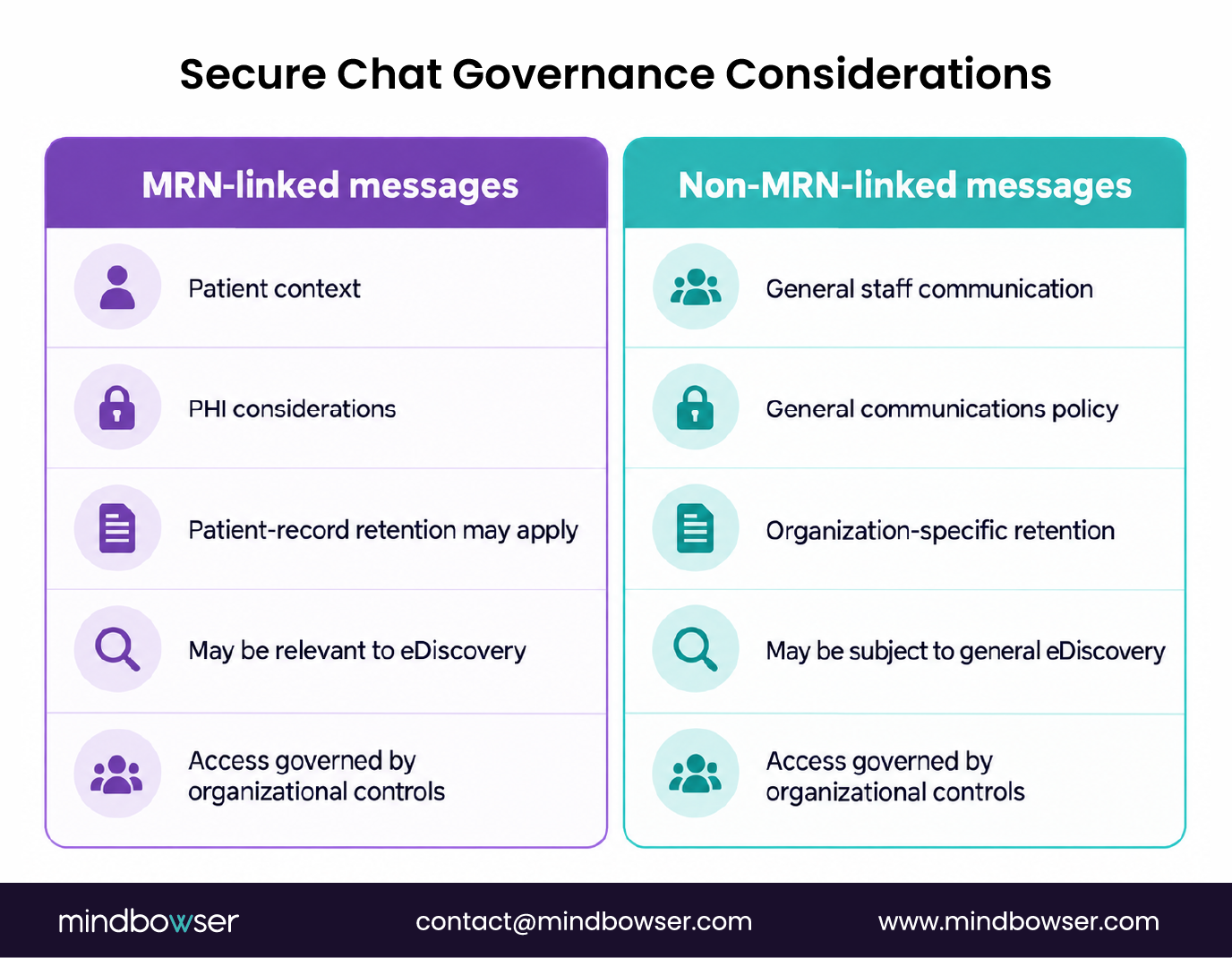
For legal and compliance teams, this is the sharper version of the monitoring question. And the answer is: it depends on whether the message is MRN-linked.
MRN-linked Secure Chat messages are part of the patient record under HIPAA’s definition of a designated record set (45 CFR 164.501). That means they can be requested by the patient via right-of-access, and they are discoverable in litigation involving that patient encounter. If a physician-to-nurse message about a patient’s deterioration went through Secure Chat and carried the MRN, it is part of the discoverable record in a malpractice case. Plan for that before you need to.
Non-MRN-linked messages, general staff communications without patient context, are internal communications. They fall under the health system’s general communications retention and eDiscovery policies, not HIPAA’s medical record rules. They are still discoverable in litigation, under general communications rules rather than PHI rules.
The legal hold gap most health systems have: eDiscovery readiness plans usually cover email, EHR structured records, and shared drives. Secure Chat rarely makes that list. When a patient encounter becomes a litigation matter, a legal hold that does not specifically trigger Secure Chat message preservation creates a defensibility risk.
Retention periods for Secure Chat messages are configurable at the Epic system level. For MRN-linked messages, health systems apply medical record retention rules, commonly 7-10 years for adult records, though state-specific rules vary and should be verified before configuring the policy. For eDiscovery production, Secure Chat data can be exported via Epic’s report tools, but the export format rarely matches what litigation hold platforms expect natively. Budget for a transform step.
Compliance teams reviewing their business associate agreement obligations should explicitly assess whether Secure Chat data flows to any BAA-covered downstream system, particularly if an archiving or eDiscovery platform is in scope.
Start a Conversation, we work with healthcare IT and legal teams on Epic data governance, including Secure Chat audit scope and configuration.
How Do IT Teams Configure and Audit Epic Secure Chat?
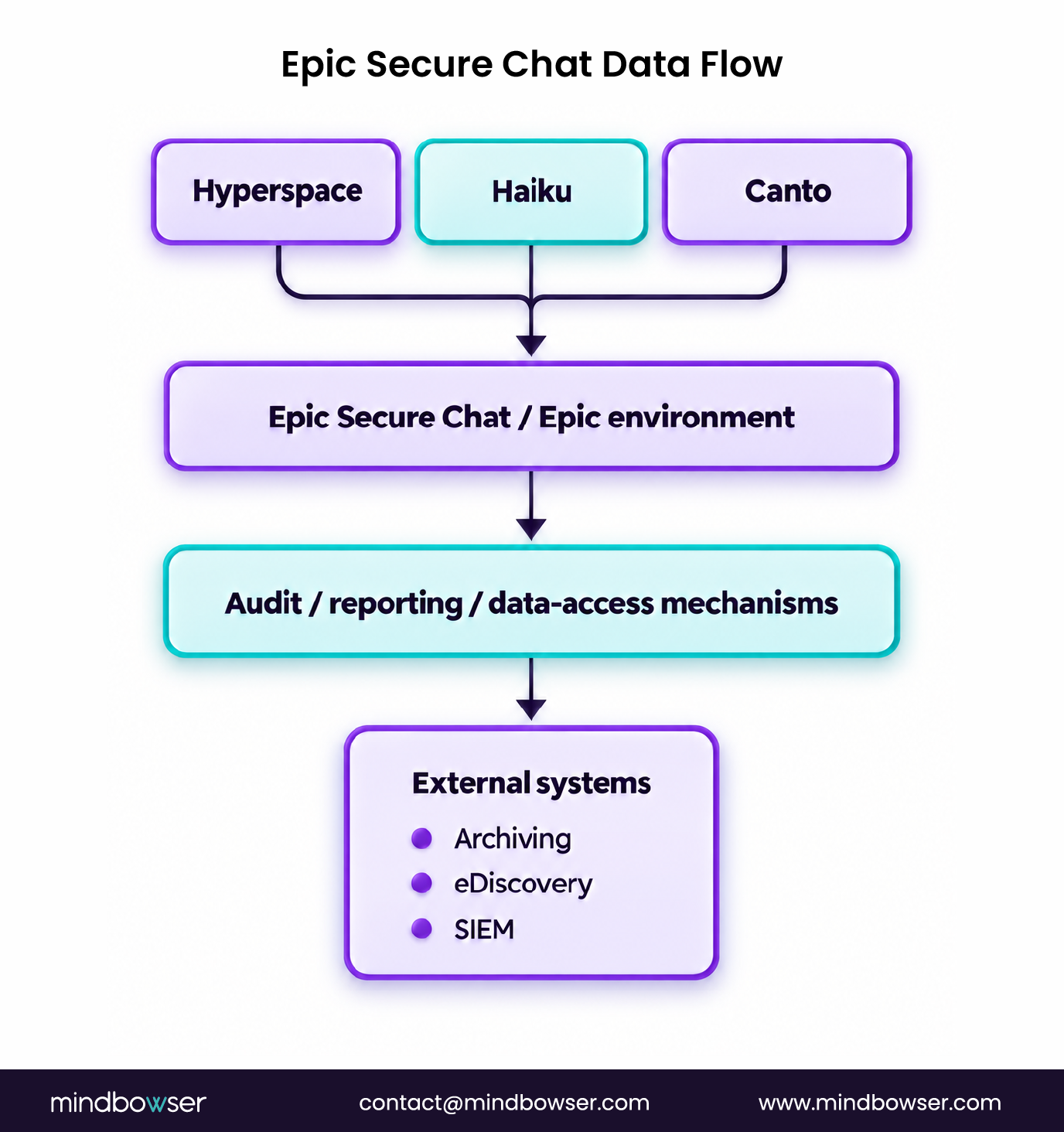
Those compliance questions turn into three configuration decisions you own: what gets retained, who can access the audit logs, and whether Secure Chat data feeds anything outside Epic.
Secure Chat configuration lives in the Epic Chronicles database. Retention period, user access tiers, and message archiving are controlled via Epic’s security model and Chronicles configuration, not via a separate admin UI. Changing any of it means pulling in your Epic security team, and for retention policy, your medical records department too. Budget the calendar time, not just the build time.
Audit log access requires an Epic security role assignment, and the audit-control obligation behind it sits in 45 CFR 164.312(b). Access is usually limited to compliance, security, and IT administration. Not to clinical managers. The audit log shows who sent, who received, when, and whether the message was patient-linked. It will not show you message content in a searchable dashboard. Content retrieval means a report pull against Chronicles.
External archiving integration, for organizations that want Secure Chat data flowing into a third-party compliance archiving platform for legal hold, requires custom interface work. Epic does not have a native Secure Chat export API. Data must be pulled via Epic reporting tools or direct Chronicles access, which requires Epic DBA-level access (what MB’s Epic practice refers to as “Chronicles DBA access”). Unlike the structured HL7 feeds that run through Epic Bridges, Epic’s native interface engine for routine data exchange, Secure Chat archiving sits outside that pathway entirely and has to be built as a standalone extract. This is a real integration build, not a configuration toggle.
SIEM integration, for organizations that want to monitor Secure Chat access patterns as part of security event monitoring, is possible via Epic’s audit log export. The log format is Epic-native, so expect to parse and transform it before any standard SIEM will take it.
One platform note: organizations running Epic Hyperdrive (web client) versus Hyperspace (thick client) have the same Secure Chat functionality. The difference is in deployment, mobile access, and MDM policy governance differ by client type.
Can Epic Secure Chat Be Integrated with External Messaging or Archiving Platforms?
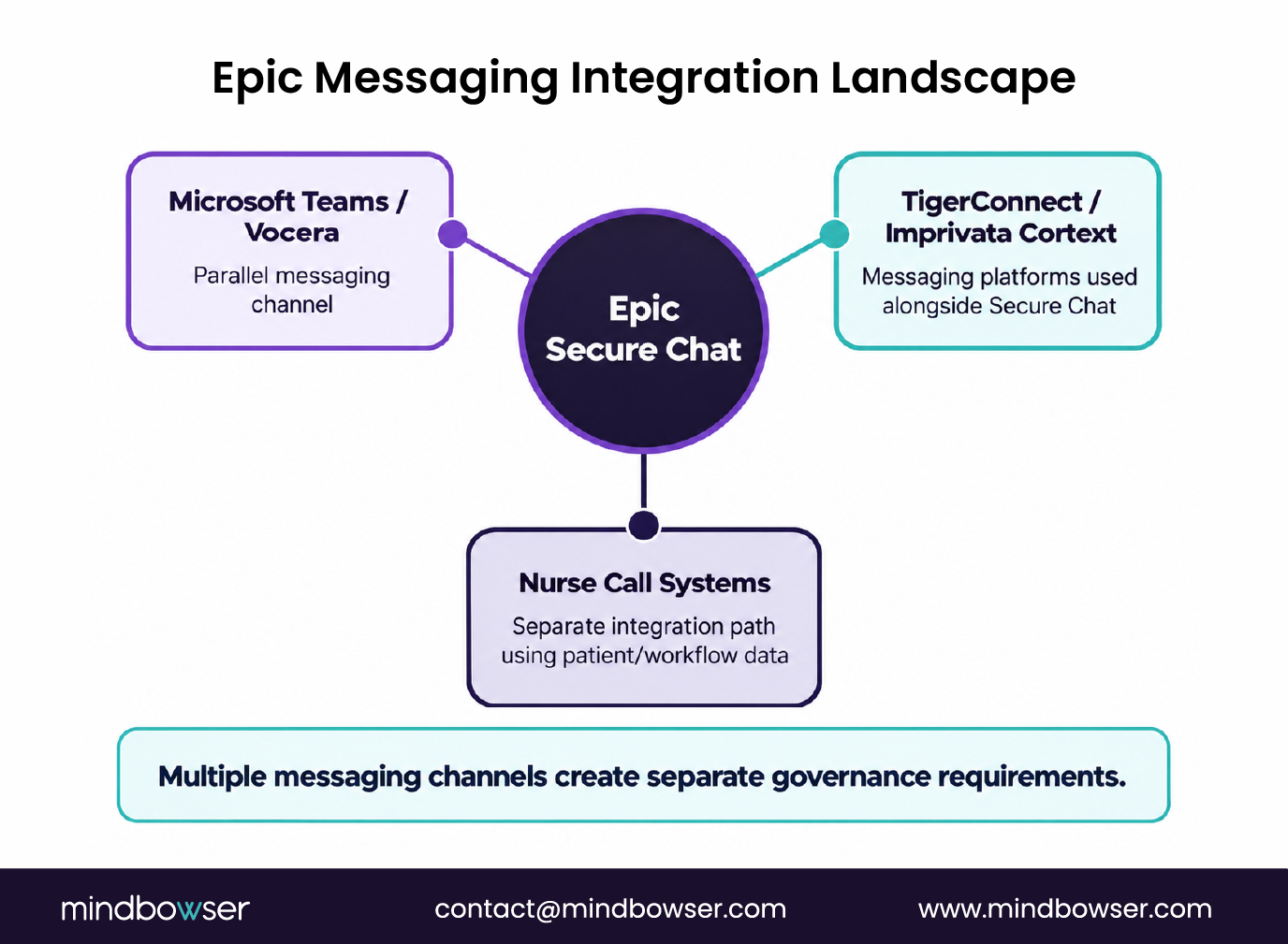
Some health systems want Secure Chat data to flow into enterprise archiving for legal hold, unified communications dashboards, or nurse call systems. Here is what that integration actually involves.
Epic does not publish a native Secure Chat API for external integration. Integration requires Chronicles database access or Epic’s Report Delivery tools, both of which require Epic DBA-level technical access. This is not a point-and-click integration, it is dedicated Epic interface work that touches the same access layer as any custom Epic integration project.
Nurse call system integration: Rauland, Hill-Rom/Baxter, Ascom; these systems interface with Epic primarily for patient data (ADT events, room assignments, care team assignments). Clinical messaging alerts route via Epic Care Everywhere and ADT event triggers, not via Secure Chat payloads. Secure Chat remains within the Epic clinical messaging layer.
Unified communications platforms like Microsoft Teams and Vocera can integrate with Epic for care team messaging, but these integrations bypass Secure Chat and create a parallel messaging channel. The governance question this creates is: which channel carries PHI, and who governs each? Health systems that deploy Teams or Vocera alongside Secure Chat need an explicit policy for which conversations go where.
Third-party HIPAA-compliant messaging platforms, TigerConnect and Imprivata Cortext, are sometimes deployed alongside Secure Chat in organizations where mobile messaging predates their Epic deployment. That leaves you with dual-channel governance: two HIPAA-compliant systems carrying clinical conversation, each with its own audit log, its own retention policy, and its own eDiscovery exposure. Two systems, two sets of obligations.
We have built Chronicles-level access for Epic integrations at health systems, which is the same access surface a Secure Chat archiving or eDiscovery build depends on. If you are scoping one, that is the layer to get right first.
Request an Assessment, we help healthcare IT teams map Epic messaging governance and integration requirements, including Secure Chat data flow and archiving feasibility.
PakarPBN
A Private Blog Network (PBN) is a collection of websites that are controlled by a single individual or organization and used primarily to build backlinks to a “money site” in order to influence its ranking in search engines such as Google. The core idea behind a PBN is based on the importance of backlinks in Google’s ranking algorithm. Since Google views backlinks as signals of authority and trust, some website owners attempt to artificially create these signals through a controlled network of sites.
In a typical PBN setup, the owner acquires expired or aged domains that already have existing authority, backlinks, and history. These domains are rebuilt with new content and hosted separately, often using different IP addresses, hosting providers, themes, and ownership details to make them appear unrelated. Within the content published on these sites, links are strategically placed that point to the main website the owner wants to rank higher. By doing this, the owner attempts to pass link equity (also known as “link juice”) from the PBN sites to the target website.
The purpose of a PBN is to give the impression that the target website is naturally earning links from multiple independent sources. If done effectively, this can temporarily improve keyword rankings, increase organic visibility, and drive more traffic from search results.
Comments are closed, but trackbacks and pingbacks are open.