I. Introduction
Healthcare-associated infections continue to challenge hospitals clinically, operationally, and financially. Infection prevention teams are expected to detect diseases earlier, limit transmission, and meet strict reporting obligations, often with limited staffing and growing data volume. These pressures increased during COVID-19 and remain elevated as organizations face higher acuity patients and more complex care environments.
Epic Bugsy emerged as a core infection control capability for hospitals running Epic, designed to bring surveillance, isolation management, and regulatory reporting directly into the electronic health record. Instead of relying on retrospective chart reviews or disconnected reporting tools, Epic Bugsy enables infection preventionists and clinicians to monitor infection risk in near-real time using microbiology data already flowing through the system.
For hospital leaders, Epic Bugsy addresses a critical gap. Infection control is no longer just a quality initiative. It directly impacts patient safety scores, reimbursement, staff safety, and public reporting metrics. By embedding infection surveillance into daily clinical workflows, the Epic Bugsy module helps organizations move from reactive response to proactive prevention.
This guide is written for infection preventionists, clinicians, quality leaders, and health IT executives who want a clear, practical understanding of what Epic Bugsy is, how it functions in real hospital environments, and where its capabilities can be extended as infection control programs mature. It also examines how custom Epic-compatible platforms can complement Epic Bugsy when standard workflows no longer meet advanced surveillance, analytics, or reporting needs.
Epic Bugsy is not just a reporting tool. It is an operational layer for infection control that integrates lab data, clinical documentation, and compliance workflows within the EHR, where prevention decisions are made.
II. What Is Epic Bugsy?
Epic Bugsy is Epic’s dedicated infection control module designed to help hospitals track, manage, and prevent healthcare-associated infections directly inside the electronic health record. Formerly known as Epic Infection Control, the Epic Bugsy module was built to support infection preventionists and clinical teams who need timely, reliable visibility into infection risk without leaving the Epic environment.
At its core, Epic Bugsy relies heavily on microbiology and virology data to identify patients at risk for infection and those who may require isolation precautions. Instead of treating infection surveillance as a downstream reporting task, Epic Bugsy embeds it into day-to-day clinical workflows, where decisions are made in real time.
A. What is Epic Bugsy actually doing behind the scenes?
It continuously evaluates laboratory results, patient documentation, and care context to surface potential infection events as they occur. That means infection prevention teams are no longer dependent on periodic chart review or manual spreadsheet tracking to identify issues.
Key characteristics of Epic Bugsy include:
- A patient-centric design that ties infection risk directly to the active patient chart
- Continuous monitoring of microbiology results flowing through Epic Beaker
- Automated identification of patients who may need isolation or precaution protocols
- Built-in support for regulatory reporting when infections are acquired during admission
For clinical users, this integration matters. Infection indicators appear alongside orders, notes, bed locations, and care activities, reducing the cognitive burden of switching between systems or reconciling disconnected data sources.
B. Why does this matter for hospital leadership?
Because infection control is no longer just a quality initiative, it directly affects safety metrics, public reporting, reimbursement, and workforce protection—Epic Bugsy positions infection surveillance as an operational function, not a retrospective audit.
C. What is Epic Bugsy not?
It is not a standalone analytics platform or a generic reporting tool. The Epic Bugsy module is designed to work best when microbiology data, clinical documentation, and infection prevention workflows are well configured and aligned inside Epic.
Epic Bugsy serves as the connective tissue among lab data, clinical context, and compliance requirements, enabling infection prevention teams to detect risks earlier and respond faster without leaving the EHR.
III. Core Features of Epic Bugsy
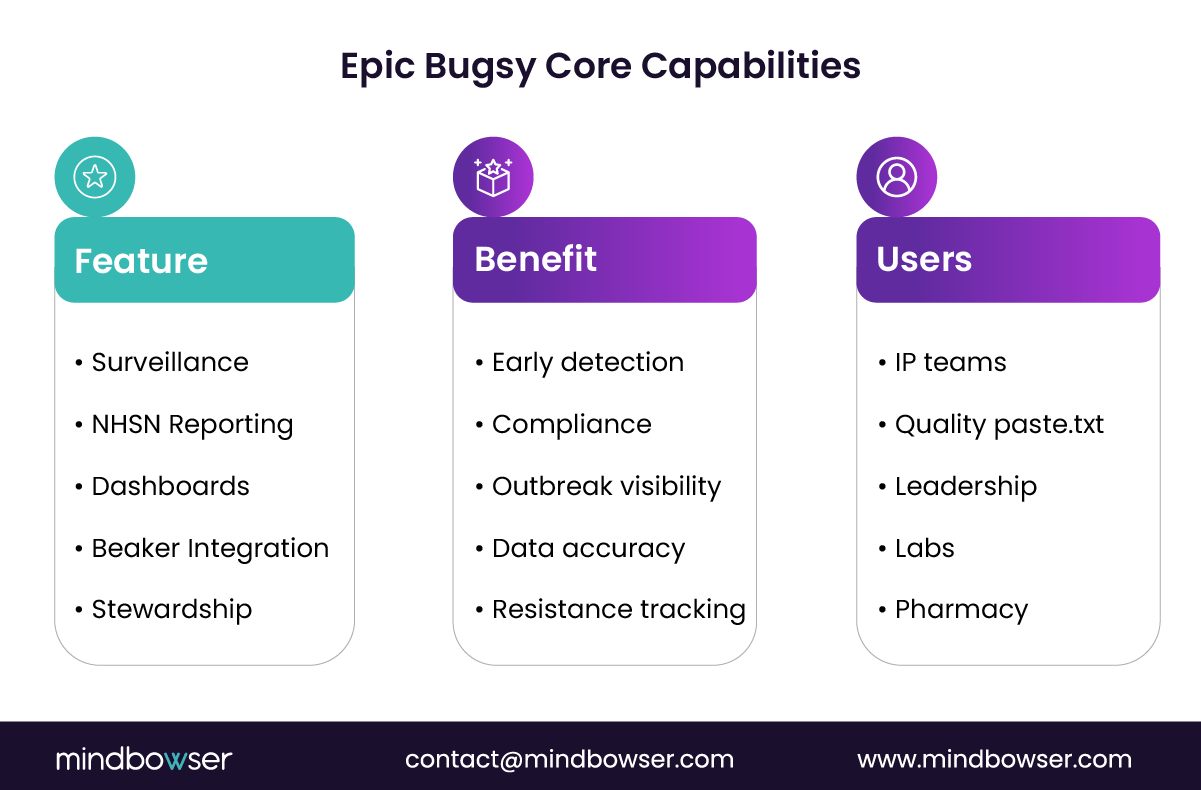
Epic Bugsy is designed to support infection prevention as a continuous operational function, not a periodic review exercise. Its core features focus on surveillance, reporting, visibility, and stewardship, all embedded within the Epic environment.
A. Real-Time Infection Surveillance
Epic Bugsy delivers real-time infection surveillance by continuously evaluating patient data and microbiology results as they are entered into the EHR. Rather than waiting for end-of-day reviews or manual audits, infection prevention teams receive ongoing signals when infection criteria may be met.
1. How does this work in practice?
The Epic Bugsy module automatically flags patients with abnormal laboratory findings and compares those results against clinical documentation, such as lines, drains, and airways. This allows early identification of possible CAUTI or CLABSI events while patients are still admitted.
Key surveillance capabilities include:
- Continuous scanning of microbiology and virology data
- Automated population of infection cohorts based on defined criteria
- Early identification of patients who may require follow-up or intervention
This approach helps infection preventionists move faster, especially in high-volume inpatient settings where manual surveillance is no longer sustainable.
B. Automated Reporting & Regulatory Compliance
Regulatory reporting remains one of the most resource-intensive responsibilities for infection prevention teams. Epic Bugsy addresses this by automating case creation and abstraction for reporting to CDC, NHSN, and state health departments.
1. Why does automation matter here?
Manual reporting introduces delays, inconsistencies, and audit risk. Epic Bugsy standardizes how reportable infections are identified and documented, reducing variation across reviewers.
Core reporting functions include:
- Automated abstraction of infection cases
- Streamlined uploads to regulatory databases
- Built-in support for CDC, NHSN, and Joint Commission standards
For hospitals managing surgical site infection reporting, the Epic Bugsy module automatically tracks surgical patients and associated microbiology data, reducing manual reconciliation effort.
C. Dashboards & Analytics
Epic Bugsy provides dashboards that give infection prevention teams a daily, actionable view of infection risk across the organization—these dashboards surface counts of patients identified by the lab as having specific organisms or risk factors.
1. What does this mean for day-to-day operations?
Instead of digging through reports, teams can quickly see where attention is needed and prioritize follow-up by unit, organism, or patient population.
Dashboard capabilities support:
- Daily “heads-up” counts of identified organisms
- Trend monitoring by location or timeframe
- Faster identification of potential clusters or outbreaks
For clinical leaders and administrators, this visibility supports faster decision-making during emerging infection events.
D. Antimicrobial Stewardship Support
Epic Bugsy also supports antimicrobial stewardship efforts by linking microbiology results with antibiotic usage patterns. This allows pharmacy and clinical teams to evaluate whether antimicrobial therapy aligns with identified organisms and resistance trends.
1. Why is this connection meaningful?
Inappropriate or prolonged antibiotic use contributes to resistance and increases the risk of downstream infections. By monitoring usage alongside lab data, teams gain better insight into prescribing patterns.
Stewardship support includes:
- Monitoring antibiotic utilization
- Reviewing resistance patterns over time
- Supporting data-driven stewardship interventions
E. Integration With Epic Beaker & Lab Systems
Epic Bugsy relies heavily on microbiology and virology data, making tight integration with Epic Beaker essential. This integration ensures lab results and specimen-tracking data flow directly into infection-prevention workflows without manual intervention.
1. What does Epic Beaker integration enable?
It improves data accuracy, speeds detection, and allows infection prevention teams to trace potential transmission pathways within the facility.
Integration benefits include:
- Direct linkage between lab results and surveillance rules
- Reduced data duplication and reconciliation
- Earlier identification of infection clusters by unit or provider
The Epic Bugsy module integrates surveillance, reporting, analytics, and lab integration into a single workflow, helping hospitals respond to infection risk more quickly and consistently.
IV. How Epic Bugsy Fits Into Hospital Workflows
Epic Bugsy is most effective when it operates within everyday clinical and infection-prevention workflows, not as a standalone reporting layer. The Epic Bugsy module is designed to sit quietly in the background, continuously evaluating patient data and surfacing risk only when action is needed.
A. Infection Flagging in Daily Operations
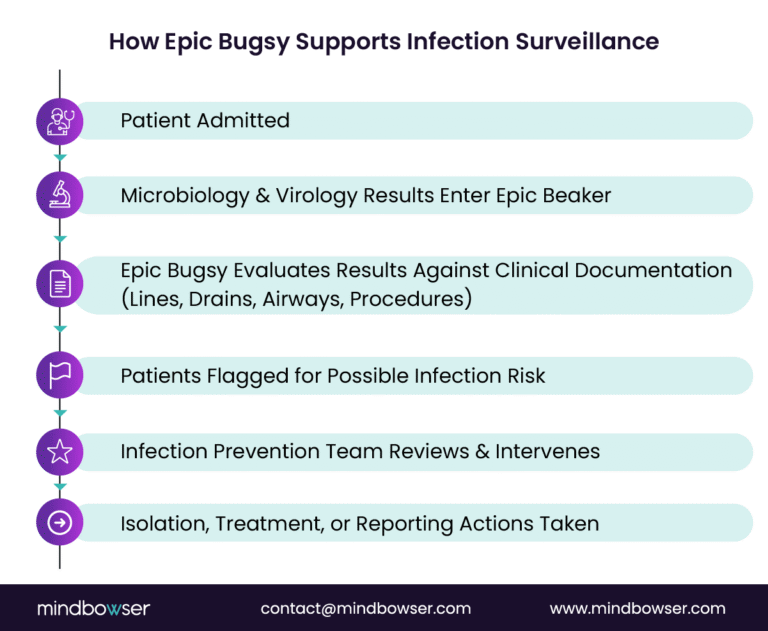
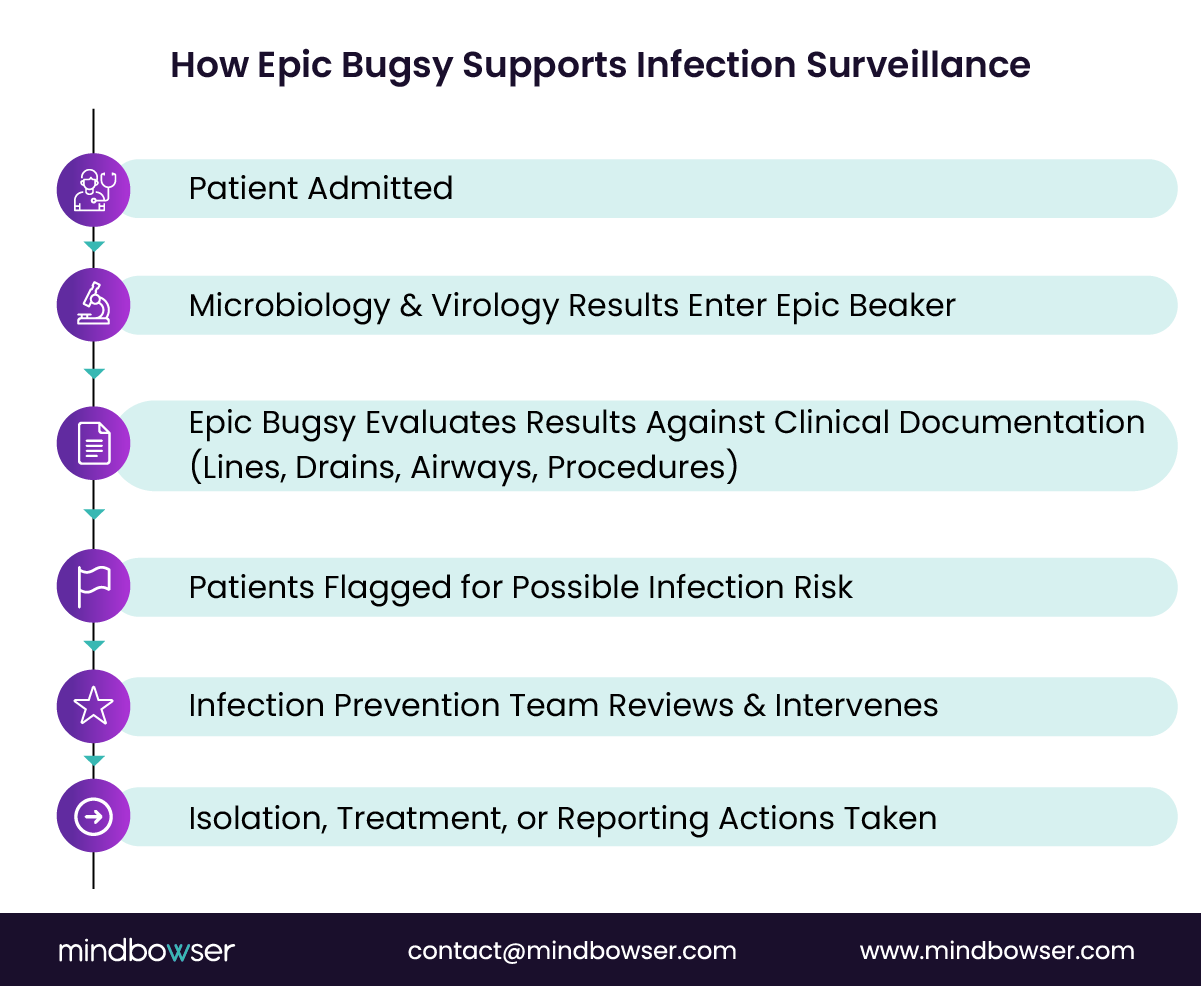
At the workflow level, Epic Bugsy automates the identification of infection populations by evaluating abnormal microbiology results as they are entered into the system. These results are not viewed in isolation. They are assessed alongside clinical documentation, including lines, drains, and airways, to determine whether patients meet criteria for possible infection events such as CAUTI or CLABSI.
1. Why is this important for infection prevention teams?
Because it removes the need to manually cross-reference lab data with chart documentation, a task that becomes unmanageable at scale.
Workflow impact includes:
- Automatic population of at-risk patient cohorts
- Earlier identification of possible reportable events
- Reduced dependence on retrospective chart review
B. Isolation Protocols and Clinical Decision Support
Epic Bugsy also helps determine when patients may require isolation precautions. By evaluating chart documentation, laboratory results, and contextual information such as bed location, the system flags patients who may need isolation or additional precautions.
1. How does this help frontline staff?
It supports more consistent application of isolation protocols, especially in busy inpatient units where delays increase exposure risk.
Isolation-related workflow support includes:
- Identification of patients requiring isolation review
- Visibility into isolation status within the patient chart
- Alignment between lab findings and infection control actions
C. Cross-Team Collaboration and Configuration
Effective use of Epic Bugsy depends on cross-team collaboration. Infection preventionists, microbiology labs, informatics groups, and Epic analysts must work together to ensure that testing panels and results are configured discretely to ensure accurate surveillance and reporting.
1. What happens when this alignment is missing?
Surveillance gaps appear, reporting accuracy declines, and teams lose confidence in the data.
Key collaboration points include:
- Discrete configuration of microbiology and molecular testing panels
- Alignment between lab workflows and surveillance rules
- Ongoing validation of infection criteria and reporting logic
D. Reporting and Public Health Coordination
Once infection events are identified, Epic Bugsy supports streamlined reporting workflows to state health departments and national surveillance systems. Surgical patients are automatically tracked for surgical site infection reporting, reducing manual effort and improving consistency.
1. Why does this matter during high-volume periods?
Reporting demands do not decrease during outbreaks or staffing shortages. Automation helps teams maintain compliance even under pressure.
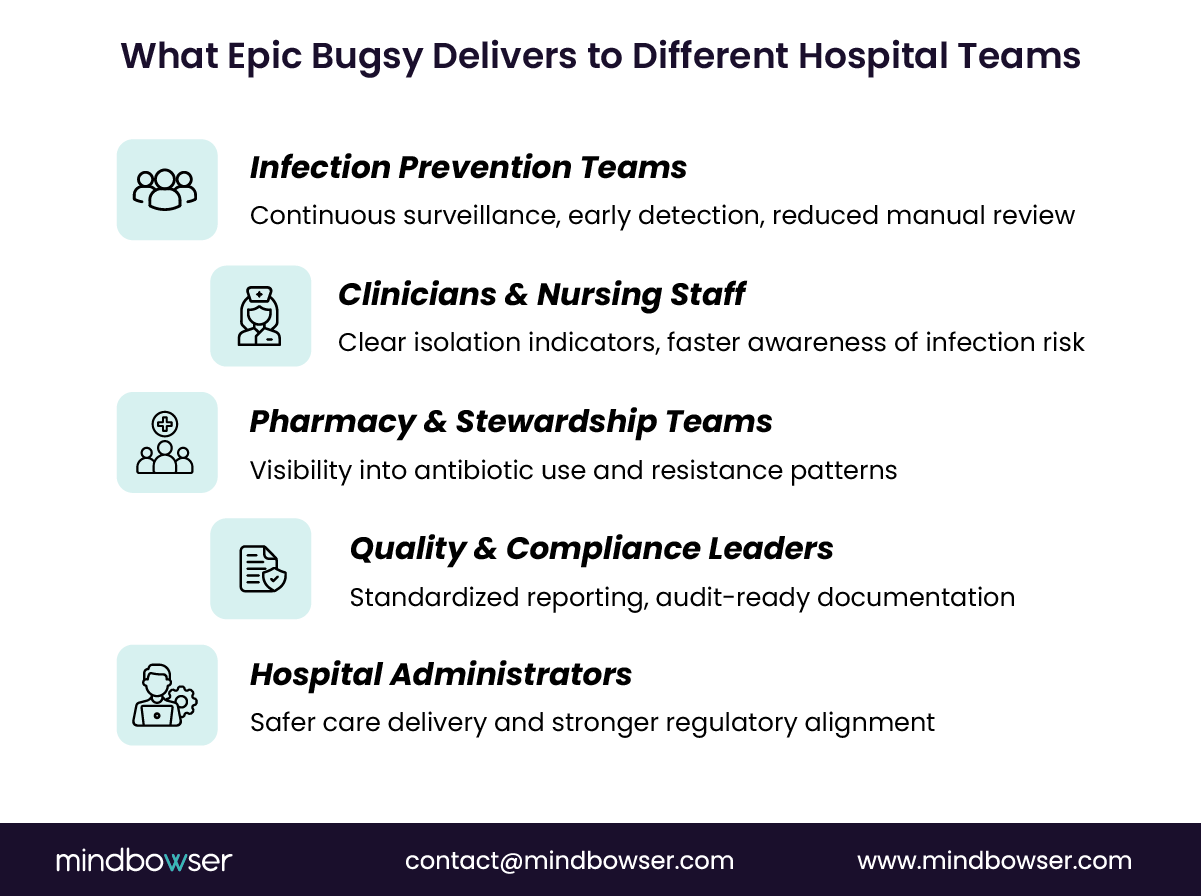
Epic Bugsy fits into hospital workflows by automating surveillance, supporting isolation decisions, and streamlining reporting, allowing infection prevention teams to focus on intervention rather than data wrangling.
Berita Terkini
Berita Terbaru
Daftar Terbaru
News
Jasa Impor China
Berita Terbaru
Flash News
RuangJP
Pemilu
Berita Terkini
Prediksi Bola
Technology
Otomotif
Berita Terbaru
Teknologi
Berita terkini
Berita Pemilu
Berita Teknologi
Hiburan
master Slote
Berita Terkini
Pendidikan
Resep
Jasa Backlink
Slot gacor terpercaya
Anime Batch
Comments are closed, but trackbacks and pingbacks are open.